

In a pharmaceutical cold chain, a temperature alert always triggers an immediate response. But does a temperature spike automatically mean the product is compromised? Not necessarily. This is where the Mean Kinetic Temperature, or MKT, comes into play.
What is MKT?
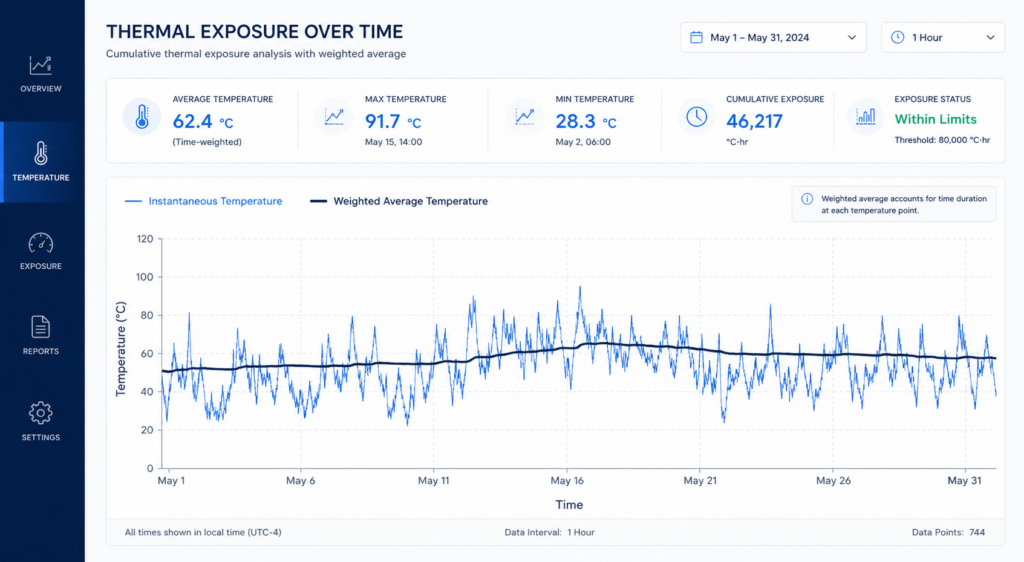
The Mean Kinetic Temperature (MKT) is a weighted average temperature that summarises the cumulative thermal exposure of a product over a defined period. Unlike a single reading, it does not treat every temperature peak as an equivalent risk: it takes into account the entire thermal history to provide a value that reflects the actual stress experienced by the product.
In practical terms, MKT helps answer a key question during an investigation into a production run: has this deviation actually compromised the quality of the product, or does the cumulative exposure remain within acceptable limits?
The guidelines for its use are set out in the United States Pharmacopeia (USP) <1>1079.2<2<>, which will be updated in August 2025 with more precise and standardised parameters.>
What has changed with the USP update of August 2025
The main change introduced by this update is the definition of precise calculation windows and temperature limits for each storage condition. This significantly reduces the scope for interpretation, which previously led to disagreements during excursion investigations.
Controlled cold temperature (2–8°C)
Temperature fluctuations between 8 and 15°C lasting less than 24 hours are permitted. The MKT limit is set at 8°C, calculated over a 24-hour period.
Controlled ambient temperature
Temperature fluctuations between 15 and 30°C for less than 24 hours are permitted, with temporary peaks of up to 40°C also permitted. The MKT limit is set at 25°C, calculated over the product’s shelf life (or 30 days if this period is unknown).
Ambient temperature in climate zone IVb (hot and humid regions)
Temperature fluctuations between 30 and 40°C for less than 24 hours are permitted. The MKT limit is set at 30°C, calculated on the same basis of possession or 30 days.
The update also specifies that all available temperature data must be used in the calculation, and that the MKT must under no circumstances be used to justify uncontrolled storage conditions.
How MKT is applied in practice

During mapping studies, it is not uncommon to observe brief deviations linked to routine operations: a door left open during a warehouse procedure, or the transfer of a product between two areas. These events may trigger an alert, without necessarily posing a real risk to product quality.
It is precisely in these situations that MKT adds value. It enables a proportionate response: rather than automatically treating every deviation as a quality incident, teams can assess whether the cumulative thermal exposure over the relevant period has actually exceeded acceptable thresholds.
><This approach is also useful from a documentation perspective. A well-structured marketing assessment, clearly linked to the parameters of the new USP 1079.2, provides a case that can be effectively defended before regulatory authorities and clients.
The limitations of MKT
MKT is a decision-support tool, not a batch release tool. It cannot, on its own, determine whether a product is suitable for marketing: this decision is based on the product’s stability data.
<>Nor should it be used to justify storage conditions that would otherwise be deemed unacceptable. The August 2025 update to USP <1> 1079.2<2> is explicit on this point.
Finally, each excursion must continue to be assessed on a case-by-case basis, even when the MKT remains within the permitted limits. A pattern of frequent, brief excursions may indicate a process or infrastructure issue that warrants attention, regardless of what the MKT indicates.
Calculating the MKT is all well and good. Having the data to do so is even better.
The MKT assessment relies entirely on the quality and completeness of the temperature data recorded throughout the shipment. A gap in the temperature history, a data logger that failed to start, or an unsupervised transfer: these are all situations that make the calculation impossible or untenable in the event of a dispute.
This is where Kelvin Solutions data loggers come into play. The Innolog™ records up to 16,000 measurement points and automatically generates a PDF report upon completion — ready for auditing. The Innotrack™ goes one step further: it transmits data in real time via 4G/5G, with instant SMS and email alerts as soon as a deviation is detected. There’s no need to wait for delivery to find out if a product has been exposed to temperature fluctuations.Comprehensive, time-stamped and traceable data: this is the foundation on which any robust marketing evaluation is built.